Decoding the Panji of Mithila · Volume VI · Chapter 27
Plagiarism, Ownership, and the Struggle over Panji Knowledge
Chapter 27 — Plagiarism, Ownership,
and the Struggle over Panji Knowledge
Panji knowledge is communal inheritance, but preservation
labor is not ownerless. The manuscript and scan traditions, the
transcription work, the indexing, and the interpretive labor all
required time, expense, and risk. Credit is therefore not vanity;
it is part of scholarly ethics.

The 2009 Genome Mapping Work
The source explicitly connects this preservation effort with the
work “Genome Mapping: Mithilak Panji Prabandh, 450 A.D. to
2009 A.D.” It also records allegations of later appropriation.
This chapter does not need to become a personal polemic; it
must instead explain why attribution matters in community
archives.

Why Ownership Is Complex
No one person owns Mithila’s ancestors. But the person who
collects, transcribes, digitizes, verifies, and publishes records
performs scholarly labor. A community archive can be shared
while still requiring precise credit for the labor that made it
accessible.

Panjikar Labor and Public Access
The older Panjikar system was based on custody, authority, and
trust. Modern public access changes that world. Digitization can
democratize knowledge, but it can also make theft easier. The
right response is not secrecy; it is transparent sourcing, clear
attribution, and open documentation.

Credit as Preservation Ethics
When credit is erased, preservation becomes exploitation.
When sources are named and labor is credited, the archive
becomes a shared foundation for further research. This is

                     © Gajendra Thakur | 226
               Decoding the Panji of Mithila, Volume VI

especially important for Dushan Panji because the material is
sensitive. Careless reuse can injure descendants; careless
appropriation can erase custodianship.

Source Note
Based on Chapter 27 plan and the source’s note regarding the
2009 Genome Mapping work, later appropriation allegations,
and the broader question of Panji preservation labor and
credit.
Source structure and verification apparatus
Editorial source apparatus. This apparatus is descriptive, not interpretive. It records the source-controlled structure used to verify that this page corresponds to formal Chapter 27 of Decoding the Panji of Mithila — Volume VI. The chapter text above is preserved from PDF pp. 227-228; formal Chapter 27 in the commit-pinned authoritative source. It is not merged with a neighboring chapter, appendix, annexure, or independent front/back-matter unit. The internal headings below come from the repository’s source-heading inventory and are retained as navigational and audit evidence; showing them here does not turn those headings into separate publications or add claims that are absent from the source.
Internal source headings
- The 2009 Genome Mapping Work
- Why Ownership Is Complex
- Panjikar Labor and Public Access
- Credit as Preservation Ethics
- Source Note
Source-text concordance
Plagiarism · Ownership · Struggle · Knowledge · communal · inheritance · preservation · labor · ownerless · manuscript · scan · traditions · transcription · work · indexing · interpretive · required · time · expense · risk · Credit · therefore · vanity · part · scholarly · ethics · Genome · Mapping · explicitly · connects · effort · Mithilak · Prabandh · records · allegations · later · appropriation · need · become · personal · polemic · must · instead · explain · attribution · matters · community · archives · Complex · person · owns · Mithila’s · ancestors · collects · transcribes · digitizes · verifies · publishes · performs · archive · shared · still · requiring · precise · made · accessible · Panjikar · Public · Access · older · system · based · custody · authority · trust · Modern · changes · world · Digitization · democratize
Boundary verification. In the formal sequence this chapter follows Volume VI Chapter 26, “Panji, Hierarchy, and Social Damage” and precedes Volume VI Chapter 28, “Tirhuta, Devanagari, Scan Copies, and the Preservation Problem”. The chapter extractor begins at the verified formal Chapter 27 marker and stops at the next verified formal chapter marker; for a final chapter it stops before recognized book-level back matter. The concordance above is generated only from distinct terms already present in this chapter’s preserved source text. It is provided for discovery, comparison, and audit, not as an automated judgment about persons, lineages, status, kinship, marriage eligibility, or historical truth.
Illustrated research apparatus
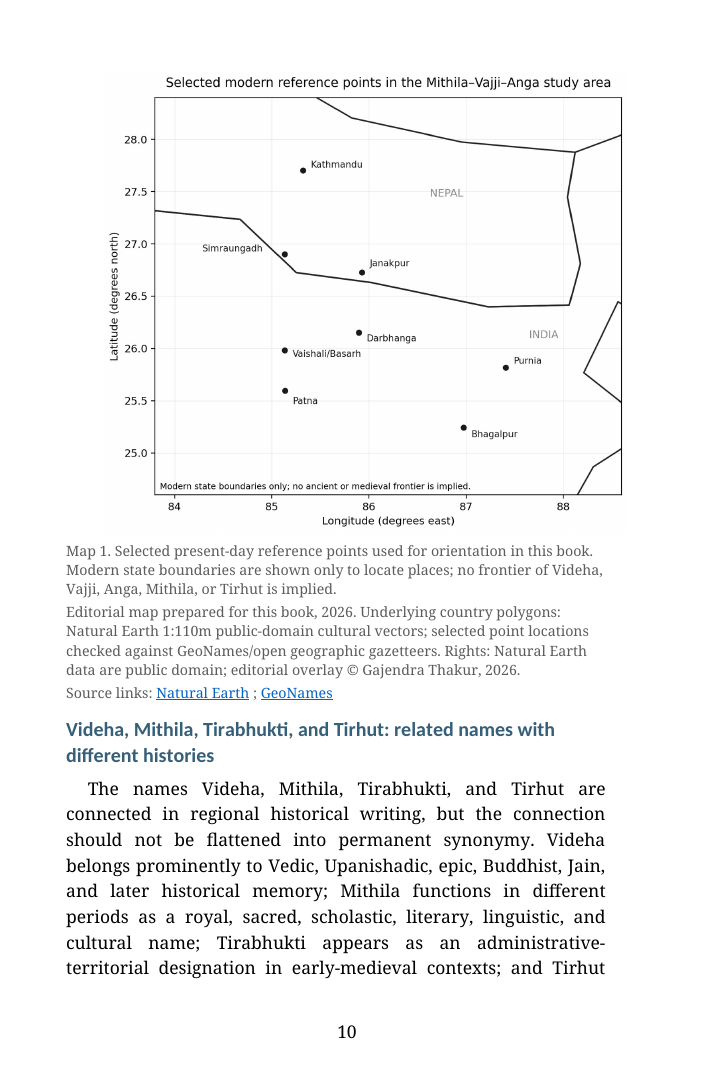
Mithila · Vajji · Anga
Chapter-specific source notes
- Primary chapter witness. Gajendra Thakur, Decoding the Panji of Mithila — Volume VI, formal Chapter 27, PDF pp. 227-228; formal Chapter 27. The HTML transcription is generated from the commit-pinned source PDF and retains the chapter boundary recorded in this edition.
- Internal structure. The repository source-heading inventory records 5 subordinate headings for this chapter: “The 2009 Genome Mapping Work”; “Why Ownership Is Complex”; “Panjikar Labor and Public Access”; “Credit as Preservation Ethics”; “Source Note”.
- Digital editorial method. The page keeps the preserved source text distinct from generated navigational, concordance, visual, and provenance apparatus. The synthetic reconstruction is explanatory only and is not evidence for an individual lineage or a determination of social or marital status.