Decoding the Panji of Mithila · Volume VI · Chapter 28
Tirhuta, Devanagari, Scan Copies, and the Preservation Problem
Chapter 28 — Tirhuta, Devanagari,
Scan Copies, and the Preservation
Problem
Dushan Panji cannot be decoded unless it is first preserved.
Preservation here means more than keeping a book in a
cupboard. It means conserving scripts, scans, transliterations,
image archives, links, and the chain of evidence from palm leaf
or Basaha paper to modern readers.

Mithilakshar / Tirhuta and Devanagari
The source repeatedly emphasizes that the Panji material was
written in Mithilakshar and transliterated into Devanagari.
This matters because a transcription is not a neutral transfer.
Every unclear sign, damaged letter, and abbreviation requires
discipline. The editor must not silently “improve” the record.

The 11,000 Image Archive
The note about an archive of around 11,000 palm-leaf images
and DVD distribution shows how preservation moved from
manuscript custody into digital reproduction. Such an archive
is valuable not only because it stores images, but because it
allows later researchers to verify the transcription.

                     © Gajendra Thakur | 227
               Decoding the Panji of Mithila, Volume VI

Scan Copies and Source Links
The source provides links to Dushan Panji, branch Panji, old
Panji copies, Uthedh Panji, patra Panji, moolgram Panji, and
other related materials. These links show that the book’s
argument should remain verifiable. A reader should be able to
see that the difficult material was not invented or silently
altered.

The Preservation Problem
The central preservation problem is that Panji is both fragile
and explosive. The physical records can decay; the social
material can provoke anger; the scripts can become
unreadable; the digital files can disappear; and transcription
errors can become false history. Preservation must therefore
combine script training, scan conservation, open citation, and
ethical caution.

Source Note
Based on Chapter 28 plan and the source notes on Mithilakshar-
to-Devanagari transliteration, the 11,000 image archive/DVD,
scan links, and related Panji source materials.
Source structure and verification apparatus
Editorial source apparatus. This apparatus is descriptive, not interpretive. It records the source-controlled structure used to verify that this page corresponds to formal Chapter 28 of Decoding the Panji of Mithila — Volume VI. The chapter text above is preserved from PDF pp. 228-229; formal Chapter 28 in the commit-pinned authoritative source. It is not merged with a neighboring chapter, appendix, annexure, or independent front/back-matter unit. The internal headings below come from the repository’s source-heading inventory and are retained as navigational and audit evidence; showing them here does not turn those headings into separate publications or add claims that are absent from the source.
Internal source headings
- Mithilakshar / Tirhuta and Devanagari
- The 11,000 Image Archive
- Scan Copies and Source Links
- The Preservation Problem
- Source Note
Source-text concordance
Tirhuta · Devanagari · Scan · Copies · Preservation · Problem · Dushan · cannot · decoded · unless · first · preserved · means · keeping · book · cupboard · conserving · scripts · scans · transliterations · image · archives · links · chain · evidence · palm · leaf · Basaha · paper · modern · readers · Mithilakshar · repeatedly · emphasizes · material · written · transliterated · matters · transcription · neutral · transfer · Every · unclear · sign · damaged · letter · abbreviation · requires · discipline · editor · must · silently · improve · record · Archive · note · around · palm-leaf · images · distribution · shows · moved · manuscript · custody · digital · reproduction · valuable · stores · allows · later · researchers · verify · Gajendra · Thakur · Decoding · provides · branch · Uthedh · patra · moolgram
Boundary verification. In the formal sequence this chapter follows Volume VI Chapter 27, “Plagiarism, Ownership, and the Struggle over Panji Knowledge” and precedes Volume VI Chapter 29, “How to Read Dushan Panji Today”. The chapter extractor begins at the verified formal Chapter 28 marker and stops at the next verified formal chapter marker; for a final chapter it stops before recognized book-level back matter. The concordance above is generated only from distinct terms already present in this chapter’s preserved source text. It is provided for discovery, comparison, and audit, not as an automated judgment about persons, lineages, status, kinship, marriage eligibility, or historical truth.
Illustrated research apparatus
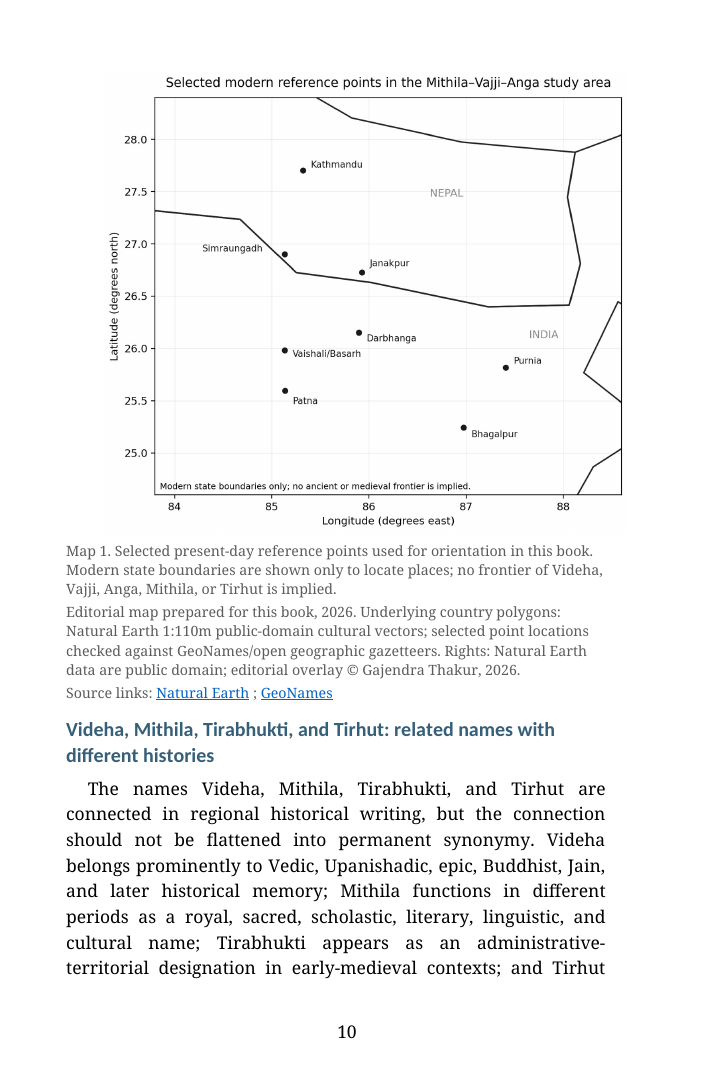
Mithila · Vajji · Anga
Chapter-specific source notes
- Primary chapter witness. Gajendra Thakur, Decoding the Panji of Mithila — Volume VI, formal Chapter 28, PDF pp. 228-229; formal Chapter 28. The HTML transcription is generated from the commit-pinned source PDF and retains the chapter boundary recorded in this edition.
- Internal structure. The repository source-heading inventory records 5 subordinate headings for this chapter: “Mithilakshar / Tirhuta and Devanagari”; “The 11,000 Image Archive”; “Scan Copies and Source Links”; “The Preservation Problem”; “Source Note”.
- Digital editorial method. The page keeps the preserved source text distinct from generated navigational, concordance, visual, and provenance apparatus. The synthetic reconstruction is explanatory only and is not evidence for an individual lineage or a determination of social or marital status.